
Berehove Commemorates the 70th Anniversary of the 1956 Hungarian Revolution
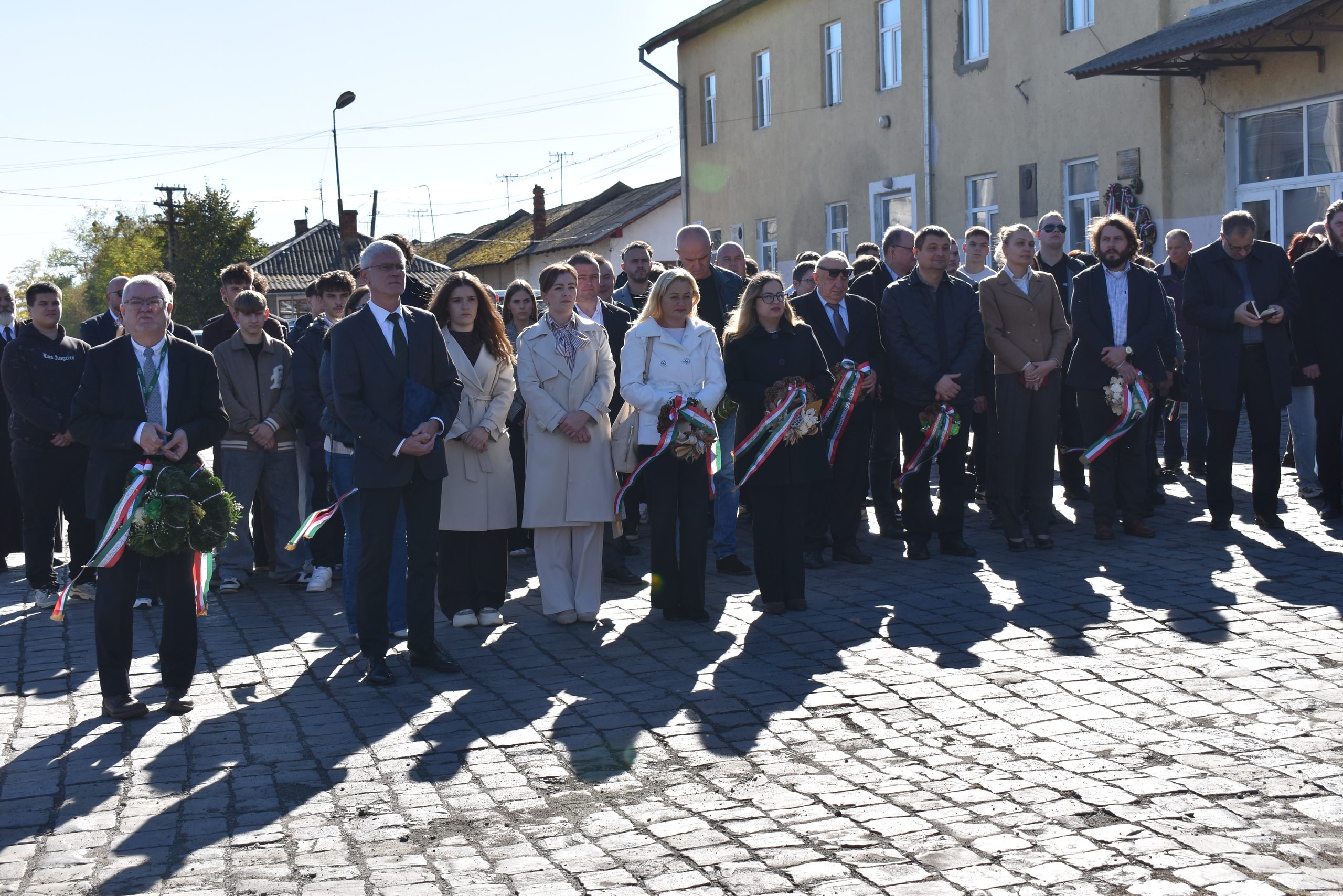
A commemorative event marking the 70th anniversary of the 1956 Hungarian Revolution and War of Independence was held at the railway station in Berehove on October 23. Organized by NGO Pro Cultura Subcarpathica and Ferenc Rákóczi II Transcarpathian Hungarian University, with the participation of the Consulate General of Hungary in Berehove, the event paid tribute to the heroes of the revolution and highlighted the enduring significance of freedom, solidarity, and national unity.
The commemoration opened with an excerpt from Sándor Márai’s poem Angel from Heaven (Mennyből az angyal), performed by Hanna Demeter, an assistant actress at the Transcarpathian Regional Hungarian Drama Theatre.
László Vida, Consul General of Hungary in Berehove, emphasized the revolution’s message of freedom and national survival, as well as the historical resilience of the Hungarian community in Transcarpathia. He recalled that the ideals of the revolution also reached the region, inspiring local young people to express solidarity with the participants of the events in Hungary. Many subsequently suffered severe reprisals.
“October 23th is a moment of reflection for every generation,” he said, stressing that freedom, tolerance, and democracy are values that must never be taken for granted.
Addressing the current situation of the Hungarian community in Transcarpathia, Vida highlighted the challenges posed by the war, economic hardship, and the separation of families. He underscored the importance of safeguarding minority rights, renewing Hungarian–Ukrainian relations, and achieving peace as soon as possible.
The commemoration continued with a performance of Csinszka’s song Felsütött a napsugára, presented by Nikolett Pivnyeva.
Attila Szakolczai, a coworker of the 1956 Institute and the Committee of National Remembrance, outlined key events of the revolution and emphasized the importance of national solidarity. He noted that a nation is more than an abstract concept: it is a community whose members can work together to achieve common goals. He encouraged those present to draw inspiration from the unity demonstrated in 1956 and to continue working toward shared objectives.
Natália Váradi, Professor at the Department of History and Social Sciences of Ferenc Rákóczi II Transcarpathian Hungarian University, spoke about the consequences of expressing solidarity with the revolution in Transcarpathia. She recalled that proceedings were initiated against 48 people and that the reprisals claimed the life of Endre Gecse, a Reformed pastor.
“1956 teaches us to never give up. There is always a way forward, there will always be a solution, and there will always be a future if a community stands together and draws strength from its unity,” she said.
Krisztina Molnár, coordinator of Pro Cultura Subcarpathica, highlighted the role of culture in preserving collective memory and passing on shared values to future generations. She emphasized that remembering the past is not merely about commemorating historical dates, but also about recognizing the questions and lessons that remain relevant today.
Representatives of the historic churches also addressed the gathering. Ferenc Taracközi, senior pastor of the Berehove Reformed Church, described the 1956 Revolution as a moment of grace ordained by God. He stressed that historic events can offer lasting guidance, encouraging people to recognize the opportunities entrusted to them and to act responsibly.
István Marosi, a Greek Catholic priest and director of the Elemér Ortutay Greek Catholic Center and College in Berehove, reflected on the Christian understanding of freedom and the importance of passing on the legacy of 1956. He emphasized that external restrictions cannot extinguish the human desire for inner freedom or the aspiration to draw closer to God.
The commemoration concluded with the laying of wreaths at the monument dedicated to the heroes of the 1956 Revolution. The memorial was erected in November 2016 by the Consulate General of Hungary in Berehove and the Berehove City Council.
The event was organized by Pro Cultura Subcarpathica and Ferenc Rákóczi II Transcarpathian Hungarian University, with the participation of the Consulate General of Hungary in Berehove. It was supported by the Government of Hungary and the Bethlen Gábor Fund Management.