
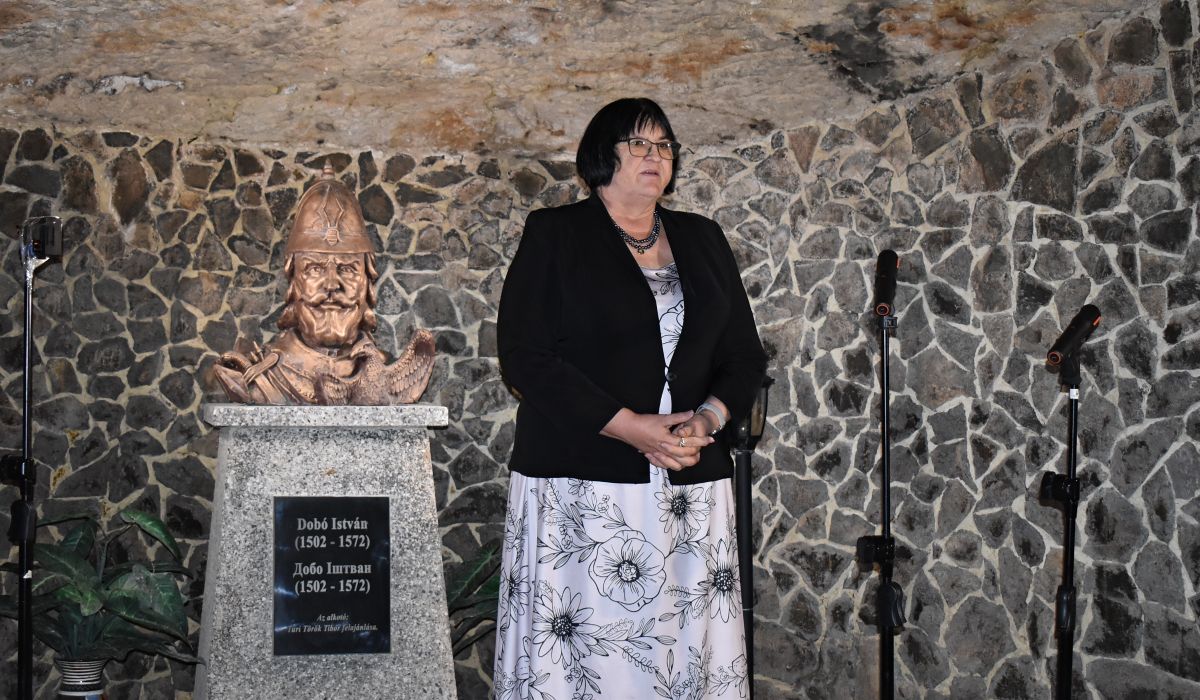
István Dobó Remembered in Szerednye
The memory of István Dobó, the celebrated captain of the Castle of Eger, was once again honored in Szerednye on September 9. The commemoration was organized for the eleventh year by the cultural association Pro Cultura Subcarpathica (PCS).
The program opened with Szilveszter Ferku’s performance of Dobó’s oath from the musical Stars of Eger. The choice of Szerednye as the venue is significant: the village is deeply connected to Hungarian history and culture. Among its historical ties, the local Buttler Castle inspired Kálmán Mikszáth’s novel Strange Marriage, the Holy Crown of Hungary was kept here for a night in 1805, painter Tivadar Csontváry Kosztka spent part of his life in the settlement, and — most importantly — Szerednye is the birthplace of István Dobó, one of Hungary’s greatest national heroes. Following his victory in the defense of Eger, Dobó was granted the estate of Szerednye and its surroundings by royal donation.
Local tradition also attributes the construction of the underground tunnel system to Dobó, built by captured Ottoman soldiers after the siege of Eger. Over time, the vast network served as a refuge, a medieval prison, and later as an ideal cellar for aging wine.
In his address, Bence Gombor, consul of Hungary’s Consulate General in Uzhhorod, quoted from Géza Gárdonyi’s Stars of Eger: “The strength of the walls is not in the stone, but in the souls of the defenders.” He noted that the message remains relevant in today’s Transcarpathia, where Hungarians strive to preserve their identity even in uncertain times. He added that Hungary continues to support the Hungarian community in Ukraine while also providing humanitarian aid to the Ukrainian people.
The audience was also treated to a performance by Hungarian artist Miklós Vesztergám.
PCS president Ildikó Orosz stressed in her speech that Dobó’s triumph was not only a military success but also a safeguard for Christianity and the survival of the peoples of the Carpathian Basin. She pointed out that Dobó defended not only the Catholic faith but also the Christianity of the region’s Slavic population, supporting, for example, Gáspár Károli’s Hungarian Bible translation. “This helped preserve the identity and culture of the peoples of the region,” she said, underlining the importance of passing Dobó’s legacy on to younger generations. Orosz expressed hope that more schools and communities will join the commemoration in the future, strengthening respect for shared history and national heroes.
The ceremony concluded with the laying of wreaths at Dobó’s bust, accompanied by Vesztergám’s rendition of the folk song I Write the Summation of Eger Castle.
The event was organized by Pro Cultura Subcarpathica with the support of the Hungarian Government and the Bethlen Gábor Fund.