
Commemoration of Gábor Bethlen in Khust
This year again, on October 12, a commemoration was held in Khust in honor of Prince Gábor Bethlen, whose legacy continues to serve as an example of perseverance, wisdom, and national unity.
The event was organized by the NGO Pro Cultura Subcarpathica, whose mission is to give strength, roots, and support to the people of Transcarpathia through knowledge of their historical past.
Since 2013, the organization has been paying tribute to the prince. In earlier years, they held a large festival in the town, but following the outbreak of the COVID-19 pandemic and the war, they have since commemorated this key figure of 17th-century Hungarian history with a quiet wreath-laying ceremony.
The occasion was not only an act of remembrance but also a profession of faith—a testament that even in the most difficult times, we must preserve our values and pass them on to future generations.
The event began with an ecumenical worship service at the local Reformed Church, where Reverend Károly Jenei and Father András Vascsuk delivered sermons.
At the commemoration, József Bacskai, Consul General of Hungary’s General Consulate in Uzhhorod, praised the historical legacy of Prince Gábor Bethlen of Transylvania, who exemplified faith, patriotism, and creativity. The prince’s timeless saying—“You cannot always do what you must, but you must always do what you can”— remains a guiding principle for Hungarians in Transcarpathia, who, despite the hardships of war, remain faithful to their faith, mother tongue, and homeland.
Bacskai emphasized that the community needs security, peace, and a predictable future, and reaffirmed that Hungary continues to support the Hungarian community in Transcarpathia, offering humanitarian, economic, and social assistance.
In closing, he expressed gratitude and respect toward those who stayed in their homeland, saying they “have done all that could be done.”
Ildikó Orosz, president of the Ferenc Rákóczi II Transcarpathian Hungarian University and Pro Cultura Subcarpathica, recalled in her speech that during Gábor Bethlen’s sixteen-year reign, Transylvania — which at that time included Khust — flourished. Under his rule, the country experienced an era of prosperity and recognition, and Bethlen was well-known and respected across Europe.
“The storms of the 20th century, however, washed away this knowledge,” she said. “Schools no longer taught the stories of our great historical figures, our past that we could hold on to. That is why the goal of every such event is to change this.”
She added: “Every Bethlen Day reminds not only Hungarians but all participants that although we cannot do everything, we must do what we can. That is how Bethlen acted—and that is how we, living in the 21st century, must act as well.”
The president explained that due to the ongoing war, the traditional Bethlen Festival — once featuring a festive parade reenacting the prince’s entry into the town square — could not be held this year either.
“We cannot do that now,” she said, “but we still gave something to the town: for the fourth year there is no festival, but for the fourth year there is a market fair. This fair provides livelihood for the people — it gives them the opportunity to sell their goods, meet one another, and spend a pleasant day together.”
In closing, Orosz emphasized:
“For us, as civil organizations and residents, it is also our task to preserve the fire of our past. When the time comes, we will return again. Pass it on, so that in the coming years there will still be those who remember the great prince.”
The central message of her speech was that the fire of the past — the flame of faith, culture, and national consciousness — must never die out. It is the community’s duty to guard this flame until it can once again burn freely and with dignity. She expressed hope that next year, in more peaceful times, the statue of Gábor Bethlen will be unveiled, and that the prince’s figure will once again stand as a visible symbol of unity and faith.
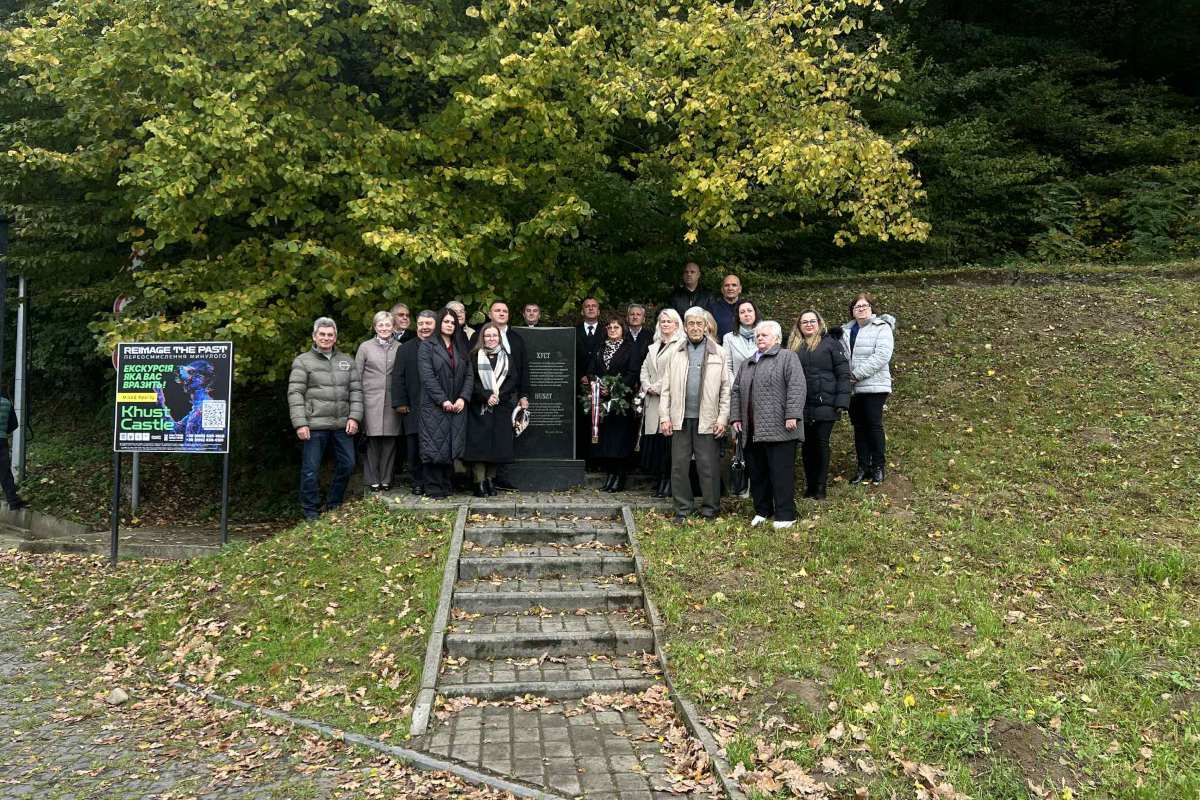
Afterward, participants walked to the memorial plaque at the foot of Khust Castle Hill, where Viktória Orbán, a staff member of PCS, recited Ferenc Kölcsey’s epigram “Khust.”
The gathering then laid wreaths at the memorial.
The event was organized by Pro Cultura Subcarpathica, with the cooperation of the local Roman Catholic and Reformed congregations and the local branch of KMKSZ (Transcarpathian Hungarian Cultural Association).
The commemoration was supported by the Government of Hungary and the Bethlen Gábor Fund Management Ltd.